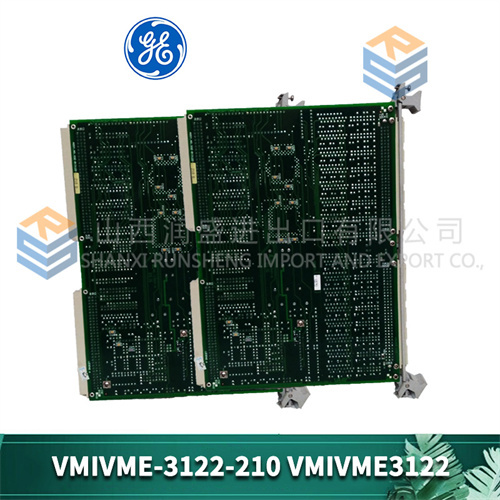
Parameters and specifications
Type: GE (General Electric) digital quantity input card module.
Use: Commonly used in industrial automation and control systems, allowing digital signals to be input into the control system to monitor and control different equipment and processes.
Communication capability: With a communication interface, you can communicate with other control devices and industrial networks to achieve data sharing and monitoring.
Modbus operation: Performing a combination of one read and one write operations in a single Modbus transaction can write to one set of 4 registers and return the contents of another set of 4x registers.
Rated voltage range: The rated voltage of DS200DCFBG1B may vary depending on the application. For example, it is mentioned that the rated voltage is between 38 and 115 VAC, and it is also mentioned that the power supply voltage is 24 VDC.
Input voltage range: For example, the DS200DCFBG1BJB has an input voltage range of 12-48VDC.
Output voltage and current:
Output voltage range: DS200DCFBG1BGB’s output voltage range is 5 VDC to 24 VDC.
Output current: The output current of the DS200DCFBG1BGB is 2 A/ channel, while the output current of the DS200DCFBG1BJB is up to 10A.
Frequency: The frequency of the board depends on the input voltage, but ranges from 0 to 500 kHz.
Communication protocol: Supports common communication protocols such as Modbus RTU.
argument
Power supply voltage:
24V DC (mentioned in some materials)
28V DC (another way to say it)
Can operate in 18V to 32V DC range
CPU: 32-bit PowerPC, 800 MHz (mentioned in some materials)
Another mentioned the use of a 600 MHz Intel EP80579 microprocessor
Memory:
2 MB Flash, 1 MB RAM (mentioned in some materials)
4 GB DDR3-1333 SDRAM (another way to say it)
256 MB DDR2 SDRAM (mentioned in another source)
I/O count: 32 analog inputs, 32 analog outputs, 16 digital inputs, 16 digital outputs (mentioned in some materials)
specification
Memory: 64 MB user memory and 64 MB user flash memory
I/O capacity: Can accommodate up to 32K bits of discrete I/O and 32K words of analog I/O
Communication ports: Two Ethernet communication ports, one RS232 port, one RS485 port, and one station manager port
Response time: 200ms (for some specific operations, such as analog input/output)
Accuracy: +/ -0.10% F.S. (for analog input/output)
specification
Processing power: Powerful processing power, able to handle complex control logic and data processing tasks
Storage capacity: Contains memory modules for storing programs and data to support the running of the application
Communication capability: Supports a variety of communication interfaces, including Ethernet, serial ports, etc., which can be used to communicate with other devices and systems
argument
Processor: The controller is equipped with a 1 GHz CPU and uses an Intel Celeron-M microprocessor.
Memory: 64 MB of non-volatile flash memory and 64 MB of battery-operated random access memory (RAM).
Power requirements: +3.3 volts DC 1.0 amp nominal value, +5 volts DC 1.2 amp nominal value.
Operating temperature: 0 to 60 degrees Celsius (32 to 140 degrees Fahrenheit), but in some sources it is mentioned that the operating temperature range may be wider, such as -40 ° C to 85 ° C.
specification
Processing speed: 1 GHZ.
Floating-point arithmetic: Supported.
Time clock accuracy: Maximum drift of 2 seconds per day.
Embedded communication: Support for RS-232, RS-485 (RS-486 in some sources).
Supported serial protocols: Modbus RTU slave, SNP, Serial I/O.
Blocks: Up to 512 blocks, with a maximum block size of 128KB.
argument
Processor: 300 MHz Intel Celeron.
Memory: 16 MB flash, 32 MB DRAM.
I/O port: One 10BaseT/100BaseTX (RJ-45) Ethernet port.
Working voltage: AC 100V-240V, power 10W.
Operating temperature: -20℃~+60℃, storage temperature: -40℃~+80℃.
Humidity: 20%~95%.
specification
Dimensions: There are mentions of 233 x 89 x 44 mm, there are also mentions of 100mm x 50mm x 25mm, this may be due to different application scenarios or configuration caused by the differences.
Weight: 0.5kg.
IS200TSVOH2B is often described as a power control board, especially for medium frequency power control.
It can also be used as a control redundancy power configuration, compatible with FIP redundancy systems, with speeds up to 100MHZ.
Input and output:
It usually has a variety of input and output voltages to meet the needs of different devices.
Protection function:
It is equipped with over current protection, over voltage protection, under voltage protection and other protection functions to ensure the stable operation and safety of the equipment.
argument
Main power supply: AC220V 50Hz (allowed in the range of 85%~110%)
Standby power supply: ensures that the monitoring device works for at least 8 hours when the main power supply is at low voltage or in a power outage
Communication protocol: Modbus-RTU
Communication mode: RS485 half-duplex bus mode, transmission distance 1km (can be extended by repeater transmission distance)
specification
Monitoring capacity: ≤128 points
Display mode: 320*240 lattice LCD
Input/Output module: built-in remote intelligent I/O module
Standby power: DC24V, 10Ah (optional larger capacity battery)
argument
Number of entries: 24
Input type: dry contact
Input signal level: 24 V DC
Output quantity: 12
Output type: Relay output
Output signal level: 24 V DC
Rated current: 10 A
Rated voltage: 250 V AC/DC
Communication interface: Two Ethernet ports (100Base-TX)
specification
Dimensions: 230 mm x 170 mm x 85 mm
Weight: 2 kg
Mounting type: DIN rail mounting
Certification: CE, UL, CSA, C-Tick, RoHS